Regenerative medicine at Halcyon means a growth factor concentrate made from a small sample of your own blood and placed under ultrasound exactly where a tendon, ligament or joint has worn or torn. It aims to prompt the body to repair the tissue rather than to mask the pain. It is done as day care under local anaesthetic, and you go home the same day.
What is regenerative medicine?
Regenerative medicine is a non-surgical injection treatment that uses a concentrate of growth factors taken from your own blood to support the repair of damaged tissue. At Halcyon in Hyderabad it is known as growth factor concentrate, and it is always placed under ultrasound guidance.
Nothing foreign is introduced. The concentrate is prepared from a blood sample taken on the day, so the treatment relies on your body’s own healing signals rather than on a drug.
How growth factor concentrate works
Growth factor concentrate works by delivering a high dose of the body’s own repair signals to a structure that has stopped healing well on its own. Blood contains platelets, and platelets carry growth factors that help organise tissue repair after an injury.
When a tendon or ligament has been overused, partly torn or slowly worn, the normal healing response often stalls. Concentrating those growth factors and placing them precisely in the damaged tissue is intended to restart that response. Because it works on repair rather than on the pain signal, it is used where a structure has worn or torn, not where a nerve is simply firing.
Which conditions regenerative medicine helps
At Halcyon, regenerative medicine is most often used for knee, shoulder, hip, foot and ankle, and elbow, hand and wrist problems, and for sports injuries. The scan decides whether it is the right choice for your case.
- Knee pain from early to moderate osteoarthritis or ligament and meniscal problems
- Shoulder pain from rotator cuff tendon problems
- Hip pain involving the tendons or bursa around the hip, or an arthritic joint
- Sports injuries to tendons, ligaments and muscles
- Foot and ankle pain such as plantar fasciitis and Achilles tendinitis
- Elbow, hand and wrist pain such as tennis elbow and golfer’s elbow
Who it suits, and who it does not
Regenerative medicine usually suits people whose pain comes from a tendon, ligament or joint that is worn or partly torn, and whose problem has not settled with rest, physiotherapy and simple painkillers. The diagnostic ultrasound at your consultation shows whether the tissue is the kind that can respond.
It is less suitable when the pain is mainly coming from an irritated nerve, where a nerve block or radiofrequency may fit better, and it is not a substitute for surgery in advanced grade 4 knee arthritis with joint deformity. If a replacement is the right answer, you will be told that plainly. An active infection, certain blood disorders or some medicines may also mean it is postponed or not advised.
The procedure, step by step
The whole process usually takes place in a single appointment at the Kukatpally centre, and most people are home within about two hours of arriving.
- The consultant takes your history and examines the painful area.
- A diagnostic ultrasound is done in the same room to find the structure that is damaged.
- If regenerative medicine is right, a small sample of blood is drawn from your arm.
- The sample is processed to concentrate its growth factors.
- The skin is cleaned and numbed with local anaesthetic.
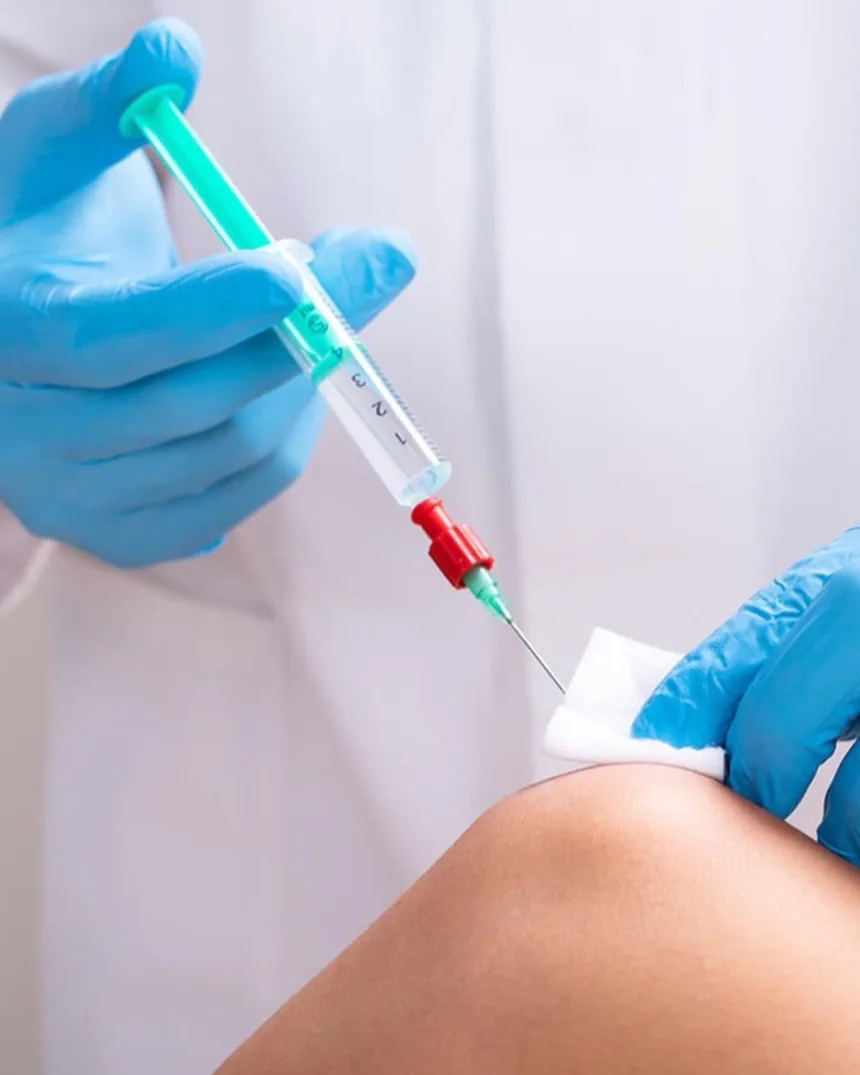
- Under live ultrasound, the concentrate is placed precisely into the damaged tissue.
- You rest briefly, receive aftercare instructions and a review date, and go home.
Recovery and aftercare
Most people walk out after a regenerative injection and go about a light day, with some soreness or a feeling of fullness at the site for a few days. This is expected, because the treatment works by stirring up a repair response.
You will be told how much to use the area, when to restart exercise and whether any painkillers should be avoided, because some anti-inflammatory medicines may interfere with the healing response. Physiotherapy or a graded exercise programme is often part of the plan. Some people need more than one injection; the consultant will tell you whether a repeat is likely for your condition.
Safety and side effects
Because the concentrate comes from your own blood, allergic reactions to it are not expected. The main side effects are those of any injection: pain, swelling or bruising at the site for a few days, and, rarely, infection.
Ultrasound guidance helps the needle reach the intended tissue and avoid nearby nerves and vessels. Contact the team if you develop increasing redness, heat, fever or pain that is getting worse rather than better, and seek urgent care if you feel unwell with a high temperature.
Conditions it is used for
Each links to how that condition is assessed and treated at Halcyon.
Questions about regenerative medicine
What is growth factor concentrate?
Growth factor concentrate is a preparation made from a small sample of your own blood, processed so that the growth factors carried by platelets are concentrated. At Halcyon it is placed under ultrasound into a worn or torn tendon, ligament or joint to prompt the body’s own repair response. Nothing foreign is added, because it comes from a sample taken on the day.
Is regenerative medicine the same as PRP?
They are closely related. Both use platelets from your own blood, and both rely on the growth factors those platelets release. Halcyon uses a growth factor concentrate, placed under ultrasound guidance. The consultant can explain the preparation used in your case and why it suits the structure the scan has found.
How long before a regenerative injection starts to work?
Improvement is usually gradual rather than immediate, because the treatment works by supporting tissue repair rather than by numbing pain. Many people notice change over the following weeks, and the site can feel sore for the first few days. How much it helps, and for how long, depends on the condition and how worn the tissue is, which the consultant will discuss with you.
Does a regenerative injection hurt?
The skin is numbed with local anaesthetic first, and you stay awake throughout, so you can tell the consultant what you feel. Most people describe pressure rather than sharp pain during the injection. Soreness or a sense of fullness at the site for a few days afterwards is common and expected, and you will be told how to manage it.
Can regenerative medicine help knee arthritis without surgery?
For many people with early to moderate knee osteoarthritis, a regenerative injection is one of the non-surgical options, alongside cooled radiofrequency and prolotherapy. Which is right depends on what the scan shows. For advanced grade 4 arthritis with joint deformity, a replacement may still be the right answer, and the consultant will say so plainly rather than treat you anyway.
How much does regenerative medicine cost at Halcyon?
The cost depends on the area treated and how many sittings are needed, so the team gives you a clear figure at the consultation, before anything is booked. Insurance cover depends on your policy and the procedure; ask the team when you call +91 77880 91092 and they can tell you what applies and what paperwork you would need.
 Prolotherapy
 Radiofrequency Ablation
 Nerve Hydrodissection & Nerve Blocks